Your Experts in Craniofacial & Plastic Surgery
At Gillette Children’s, you’ll have access to leading craniofacial surgeons and neurosurgeons who specialize in complex skull and facial conditions in children. Whether treatment begins in infancy or early childhood, our goal is to improve your child’s physical appearance and promote self-confidence.
Request a consultation appointment today, or give us a call at 651-290-8707 for more information.
The term craniofacial refers to the head and face. A craniofacial surgeon is trained in using plastic surgery to reconstruct areas of the skull and face.
A wide variety of conditions affect the face and skull. Craniofacial specialists or neurosurgeons perform surgery for traumatic injuries, complex wounds and other conditions that affect appearance and abilities. Craniofacial and plastic surgery can benefit people who have:
Conditions Treated with Craniofacial and Plastic Surgery
Head Shape Irregularities in Babies
Is Something Not Quite Right About Your Baby’s Head Shape?
Your baby is beautiful. But as the one who spends the most time with your baby, you may have noticed there's something "not quite right" with the shape of their head. Slight imperfections in an infant’s head shape is usually nothing to worry about.
However, in some cases, if left untreated the condition could worsen and might be a sign of something more serious. Compare your child’s head to the pictures below to assess your baby’s head shape.
Request an Appointment
Give us a call or request a consultation appointment online today!
Request an Appointment
Give us a call or request a consultation appointment online today!

Normal

Brachycephaly

Brachycephaly (Side)

Coronal

Lambdoid

Metopic

Plagiocephaly

Sagittal
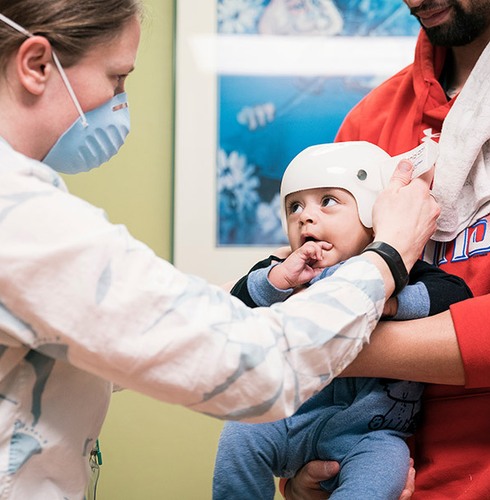
Gillette Children’s offers Talee®, an advanced 3D-printed cranial remolding helmet designed to support effective, comfortable treatment for infants. Talee features a unique two-stage, 2-in-1 orthosis that allows for controlled growth and improvement typically requiring two helmets, all within a single device. Its thin, perforated structure enhances breathability and ventilation, helping reduce sweating and skin irritation for improved comfort. Families also receive clear Talee treatment reports that track progress over time using easy-to-understand charts, 2D cross-sections, and detailed 3D visualizations of their baby’s head shape changes.
Talee® 3D-printed Orthosis
© Gillette Children's | All Rights Reserved

What Causes Irregularities in Baby's Head Shape?
A flat or misshapen head is most frequently caused by a condition called deformational plagiocephaly. Plagiocephaly is caused by external forces on baby's head – either before or after birth. Before the baby is born plagiocephaly may be caused by a crowded or small uterus, unusual positioning or a shortage of amniotic fluid. After birth, plagiocephaly is usually caused by lying and sleeping in the same position. As the head flattens, it naturally rests on the flat area, making it worse.
Sometimes plagiocephaly is related to torticollis – a condition in which a muscle on one side of the neck is too short or too tight – causing the baby to rest their head in one position.
If plagiocephaly is caught at the right time, treatment in the form of an orthosis – like the CranioCap® – is usually very successful. The best time to begin treatment is between the ages of 4 and 6 months. With a diagnosis of plagiocephaly, the more serious condition of craniosynostosis can be ruled out.
Craniosynostosis is a condition that occurs when the sutures in an infant's skull - soft tissue that holds the separate plates of the skull together – close too early, before the baby's brain has had a chance to grow. This can limit the growth of the baby's brain. If one or two of the sutures closes it may cause the head to appear misshapen, the eyes to be asymmetrical or an oddly shaped forehead. Other symptoms might include the lack of a "soft spot" on the baby's skull, a raised, firm edge under the skin of the head or slow growth of the baby's head over time.
Pediatricians cannot always diagnose craniosynostosis during a routine physical exam. If there are concerns that a baby has an abnormal head shape, additional testing, including imaging, is needed to get a better understanding of the baby's unique care needs. Most often craniosynostosis requires surgery, performed when a baby is between 4 and 8 months old.

What to Expect
Special technology scans your child's head to create a 3-D model on a computer.
Based on the model, our Orthotics, Prosthetics, and Seating experts will configure the baby helmet. You choose the design.
A fitting for the helmet typically takes place two weeks after the scan.
*Follow-up appointments may take place at St. Paul, Burnsville, Maple Grove or Minnetonka clinic locations, in addition to outreach sites throughout greater Minnesota.
Why Choose Gillette Children's?
Gillette Children’s is a global beacon of care for patients with brain, bone and movement conditions that start in childhood. Our research, treatment and supportive technologies enable every child to lead a full life defined by their dreams, not their diagnoses. Founded in 1897, Gillette collaborates with patients, families and our partners in clinical leadership, research and advocacy to set the standard of care and opportunity for children with complex medical challenges.
Request an Appointment